Oklahoma City Elite Hypnosis Blog
Agency Contact Form
Can Hypnosis Help Late-Night Snacking in Oklahoma City?
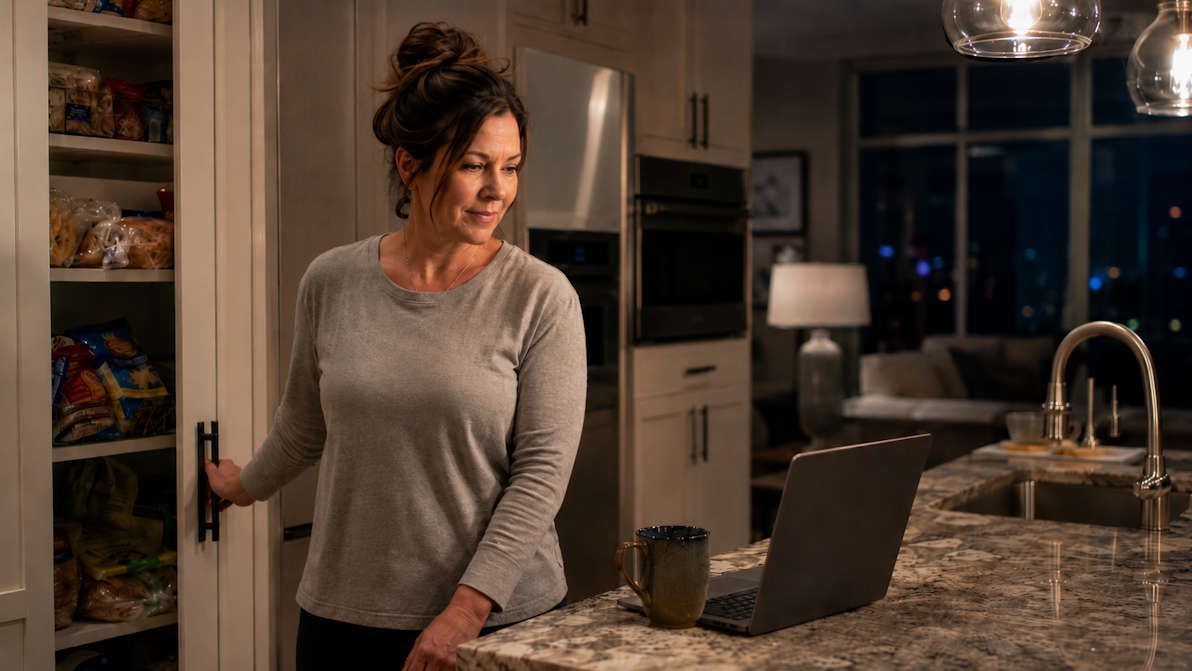
Dinner is over.
You are not necessarily hungry.
Then the evening settles in.
You sit down to watch television.
Open your laptop.
Scroll through your phone.
Walk through the kitchen.
And suddenly the thought appears:
- Something sweet would be good.
- Or salty.
- Or crunchy.
- Or maybe just something.
You open the cabinet almost without thinking.
One snack turns into another.
Then afterward you wonder:
Why did I do that? I wasn’t even hungry.
For many adults, late-night snacking is not simply a lack of knowledge about food.
You may already know what you intended to eat.
You may understand calories, portions, protein, carbohydrates and nutrition.
The problem may be that nighttime eating has become connected to stress, boredom, fatigue, reward, television, routine, cravings or the feeling that the day is finally yours.
For some adults, hypnosis may provide a useful way to work with those learned associations and automatic eating patterns.
That does not mean hypnosis guarantees weight loss.
It does not mean every evening snack is unhealthy.
And ordinary late-night snacking should not automatically be confused with an eating disorder such as Night Eating Syndrome.
The useful question is:
What is driving your nighttime eating—and is the behavior still a conscious choice?
Late Night Snacking What is it and Why's it a problem?
| Question | Quick Answer |
|---|---|
| What is late-night snacking? | Eating after dinner or close to bedtime for reasons that may include hunger, habit, stress, boredom, fatigue, reward, or environmental cues. |
| Is late-night snacking always a problem? | No. An occasional evening snack is not automatically unhealthy. The pattern matters: frequency, amount, food choice, triggers, sleep, medical needs, and whether eating feels automatic or distressing. |
| Can hypnosis help? | Hypnosis may help some adults work with learned cues, emotional triggers, routines, and automatic eating patterns. It does not replace nutrition, medical, or eating-disorder care. |
| Is this the same as Night Eating Syndrome? | No. Night Eating Syndrome is a recognized feeding or eating disorder with specific features. Ordinary late-night snacking should not be self-diagnosed as NES. |
| What is a useful first step? | Notice when the urge appears, what happened immediately before it, whether you are physically hungry, and what need the snack seems to serve. |
Is Late-Night Snacking Always a Problem?
No.
Eating something at night is not automatically a problem.
Someone may legitimately be hungry because of:
- a long day,
- exercise,
- an early dinner,
- an unusual schedule,
- increased energy needs,
- or simply not eating enough earlier.
Food is not morally good or bad based solely on the hour on the clock.
The concern is more often the pattern.
Maybe you repeatedly eat far more than you intended.
Maybe the behavior feels automatic.
Maybe you are not physically hungry but feel compelled to eat anyway.
Maybe you are trying to change your eating habits and nighttime is where those plans repeatedly fall apart. Or perhaps the food has become the main way you cope with stress at the end of the day. Those situations are different from consciously choosing an evening snack because you are hungry.
Why Do I Want to Eat at Night Even When I Am Not Hungry?
Because hunger is only one reason human beings eat.
We also eat because food can be:
- comforting,
- stimulating,
- rewarding,
- convenient,
- pleasurable,
- social,
- familiar,
- distracting,
- or simply part of a routine.
That distinction matters.
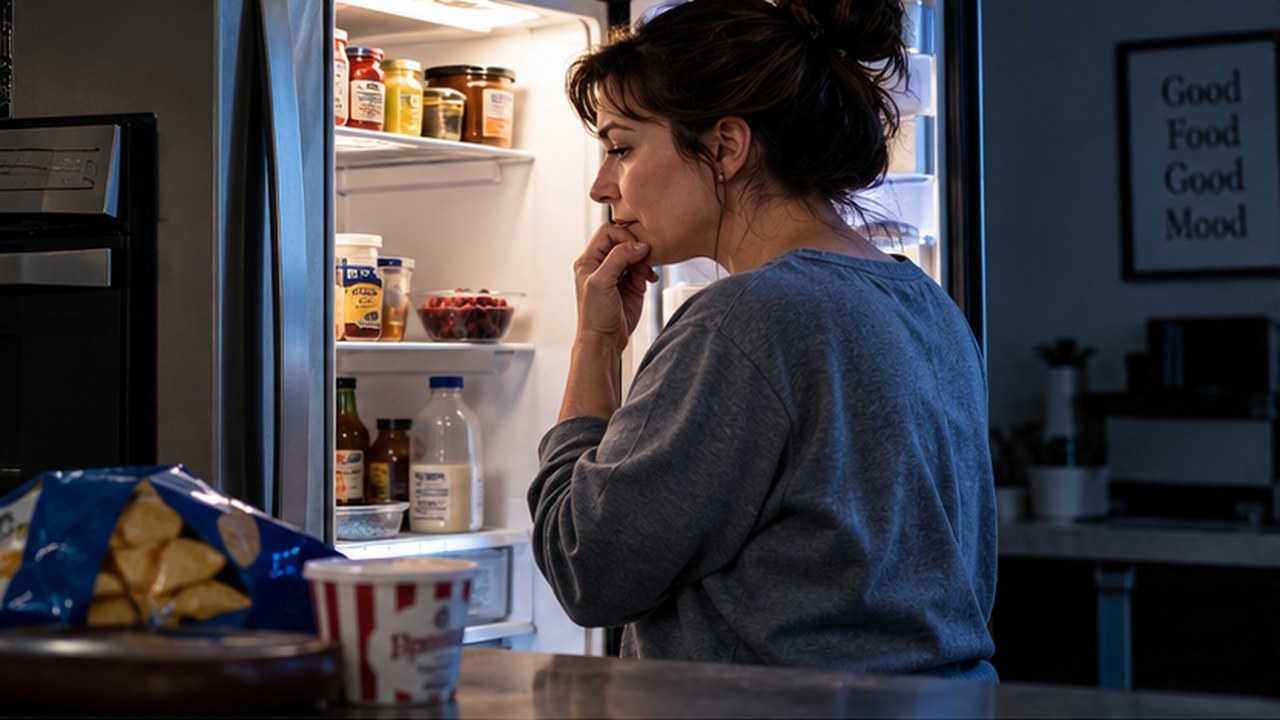
Imagine that every evening you sit in the same chair and watch the same show while eating chips. After enough repetition, the show itself may begin to cue the desire for chips.
You do not necessarily think:
I am physically hungry and therefore need food.
The thought may simply be:
This is what I do when I watch TV.
That is a learned association.
And learned associations can become surprisingly automatic.
Is It Physical Hunger or an Automatic Eating Habit?
Sometimes the answer is obvious.
Other times it is not.
Physical hunger may build gradually.
You may notice an empty feeling, reduced energy or increasing interest in several possible foods.
A cue-driven craving can feel different.
You walk into the kitchen and suddenly want something.
You see a package.
You smell food.
A commercial comes on.
You start your favorite show.
You finish cleaning the kitchen.
You become stressed.
And suddenly a very specific food sounds necessary.
Neither experience makes you a bad person.
The distinction simply gives you better information.
Physical Hunger vs. Automatic Snacking
| Signal | More Consistent With Physical Hunger | More Consistent With Habit/Trigger-Driven Snacking |
|---|---|---|
| Onset | Builds gradually | Can appear suddenly after a cue such as TV, stress, or entering the kitchen |
| Food flexibility | Several foods sound acceptable | A very specific food may feel necessary |
| Body sensations | Stomach emptiness, low energy, or other hunger cues may be present | Little physical hunger may be noticed |
| Timing | Can occur at many times depending on meals and activity | Often appears at the same time or in the same situation each night |
| After eating | Hunger generally decreases as enough food is consumed | The urge may continue because the goal was comfort, stimulation, or routine rather than hunger |
| Important note | Hunger is normal and should not be treated as failure | Habit-based eating is also common and can be explored without shame |
Why Is Nighttime Such a Common Time for Snacking?
By evening, several things may come together.
You Are Mentally Tired
Decision-making takes energy.
All day long you have been deciding:
- What to do.
- What to say.
- What to answer.
- Where to go.
- What needs attention.
By night, the idea of making one more deliberate decision can feel exhausting.
The easiest familiar behavior often wins.
Your Stress Finally Catches Up With You
During the day you may be too busy to notice how tense you feel.
At night, everything slows down.
Now the stress is obvious.
Food can become a quick way of creating comfort.
The Day Feels Like It Belongs to Everyone Else
Work.
Family.
Clients.
Appointments.
Responsibilities.
Then nighttime arrives.
Finally:
This is my time!
For some people, food becomes part of that reward.
The Environment Is Full of Cues
The snacks are visible.
The kitchen is nearby.
Television and streaming are associated with eating.
The same chair, show, bowl or cabinet may have become part of a repeated routine.
Could I Simply Be Eating Too Little During the Day?
Absolutely.
Not every late-night eating problem is an emotional or behavioral problem.
If you consistently under-eat earlier in the day, strong evening hunger may simply be your body asking for energy.
This is especially important for people who repeatedly start highly restrictive diets.
You may spend the entire day trying to be “perfect.”
Coffee for breakfast.
Tiny lunch.
Very little food in the afternoon.
Then at 8:30 p.m.:
I cannot stop eating.
That may not be a failure of discipline.
You may simply be hungry.
That is why responsible behavior-change work should not treat every desire for food as something that needs to be suppressed.
If your eating pattern involves significant restriction, medical nutrition issues, diabetes, an eating disorder or another health concern, qualified medical or nutrition guidance should come first.
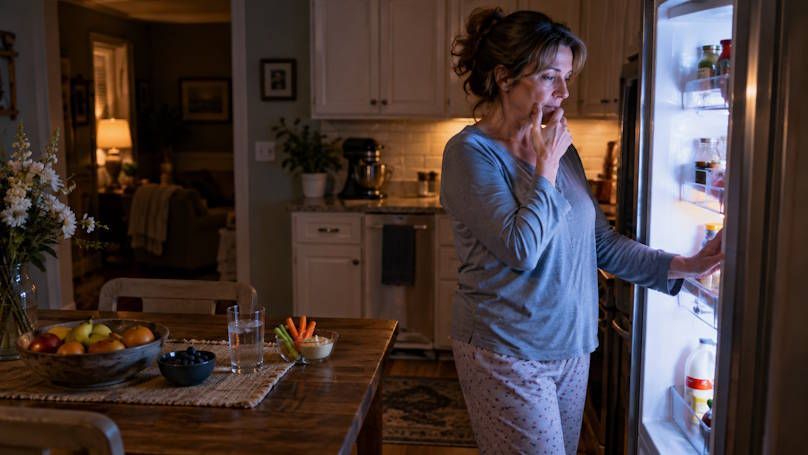
What Commonly Triggers Late-Night Snacking?
Triggers vary enormously from person to person.
A useful question is not simply:
What did I eat?
It is:
What happened immediately before I wanted to eat?
- Maybe you had a stressful phone call.
- Maybe you finally got the kids to bed.
- Maybe you finished a difficult workday.
- Maybe you became bored.
- Maybe your spouse opened a bag of snacks.
- Maybe you walked into the kitchen.
- Maybe you started your favorite show.
- Maybe you felt lonely.
- Maybe you were simply exhausted.
Once you know the trigger, the pattern becomes much easier to understand.
Common Late-Night Snacking Triggers
| Trigger | What It May Look Like | Question to Ask |
|---|---|---|
| Stress | Reaching for food after a demanding day | Am I hungry, or am I trying to change how I feel? |
| Boredom | Snacking while scrolling or watching TV | Would I still want this snack if I were engaged in something else? |
| Fatigue | Wanting quick comfort or stimulation late at night | Am I actually tired and needing rest? |
| Reward | I worked hard, so I deserve something | Can I choose a reward deliberately instead of automatically? |
| Environmental cue | Seeing snacks when entering the kitchen | Would the urge be as strong if the food were not visible? |
| Restriction earlier in the day | Strong evening hunger after under-eating | Have I eaten enough during the day? |
| Routine | Eating every night during a particular show | Is the urge tied to hunger or to the situation itself? |
What Does Stress Have to Do With Late-Night Eating?
Stress and eating can become strongly connected.
Food can temporarily change the experience of an unpleasant moment.
You have a difficult day.
You sit down.
You eat something you enjoy.
For a few minutes, attention shifts.
The behavior may provide:
- comfort,
- distraction,
- pleasure,
- reward,
- or a feeling of relief.
That does not make the behavior mysterious.
It means the food is doing a job.
If food repeatedly becomes your primary way of decompressing after stressful days, changing the pattern may require finding another way to meet the need that the food has been serving.
For adults whose eating is closely tied to stress and anxious tension, Oklahoma City Elite Hypnosis also offers hypnosis for stress and anxiety in Oklahoma City as a separate service focused on the stress response itself.
Is Late-Night Snacking the Same as Emotional Eating?
Not necessarily.
There can be overlap.
Emotional eating usually refers to eating in response to emotional states rather than physical hunger. Late-night snacking describes when the eating occurs.
So you might snack late at night because you are:
- physically hungry,
- stressed,
- bored,
- lonely,
- celebrating,
- tired,
- watching television,
- or simply following a habit.
That means not every late-night snacker is an emotional eater.
And not every emotional eater eats at night. The distinction helps us target the actual behavior instead of lumping every food-related problem together.
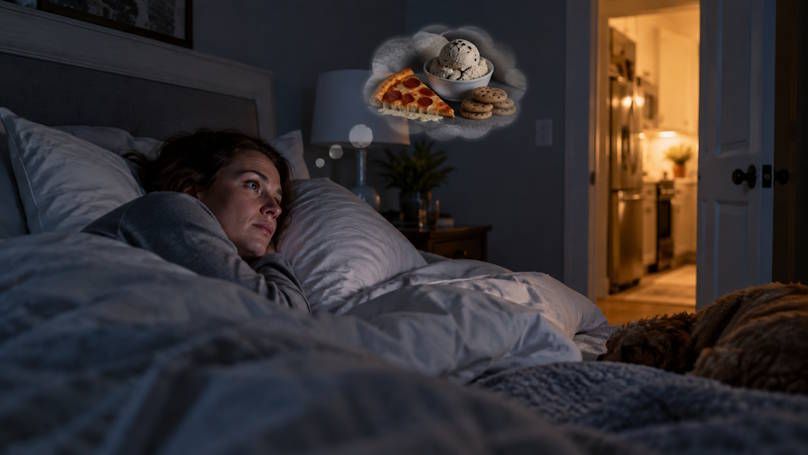
How Does a Late-Night Snacking Habit Form?
Many habits follow a simple pattern:
Cue → urge → behavior → reward
For example:
You finish dinner.
- Later you sit down to watch television. (That is the cue.) Then...j
- You begin thinking about ice cream. (That is the urge.) Then...
- You walk to the kitchen and get ice cream. (That is the behavior.) Then...
- The food creates pleasure and signals: The day is over. Now I can relax. (That is the reward.)
Repeat that process often enough and the behavior becomes easier and more automatic.
Eventually, the television may trigger the desire before you consciously decide whether you want food.
That is exactly why simply telling yourself:
I will have more willpower tonight
can be frustrating.
You are trying to interrupt a practiced pattern at the moment when the pattern is already running.
Late-Night Snacking Habit Loop
| Stage | Example | Opportunity for Change |
|---|---|---|
| 1. Cue | Dinner ends, TV starts, stress peaks, or the kitchen is nearby | Identify the recurring trigger |
| 2. Urge | A snack begins to sound appealing | Pause long enough to distinguish hunger from an automatic cue |
| 3. Routine | Go to the kitchen and choose the usual food | Experiment with a different response when hunger is not present |
| 4. Reward | Comfort, stimulation, relief, or a sense of finishing the day | Identify the reward the behavior is actually providing |
| 5. Reinforcement | The same situation prompts the same behavior tomorrow | Repeat the alternative response often enough to build a new association |
Where Can Hypnosis Fit Into This Pattern?
Hypnosis is generally used as a focused state of attention in which suggestions, imagery and mental rehearsal can be used to support behavior change.
For late-night snacking, the goal is not to convince someone that food tastes terrible.
It is not to eliminate normal hunger.
And it is not to make someone afraid of eating.
A healthier objective is increasing choice.
The cue appears.
You notice it.
Instead of moving automatically toward the usual behavior, there is a pause.
You ask:
- Am I actually hungry?
- What am I feeling?
- What do I need right now?
- Is this something I genuinely want—or simply something I normally do?
That pause can be extremely important.
What Might Hypnosis for Late-Night Snacking Focus On?
Depending on the individual, hypnosis might be used to rehearse:
- noticing a craving earlier,
- distinguishing hunger from a conditioned cue,
- walking past food without automatically taking it,
- ending the evening meal with a clearer sense of completion,
- responding differently to boredom,
- using another method to decompress after work,
- reducing impulsive eating in front of television,
- tolerating a craving without immediately acting on it,
- or making a deliberate food choice rather than an automatic one.
For adults whose late-night eating is connected to larger weight-related goals, Oklahoma City Elite Hypnosis offers weight loss hypnosis in Oklahoma City for patterns involving cravings, emotional eating, stress eating, motivation and automatic food habits.
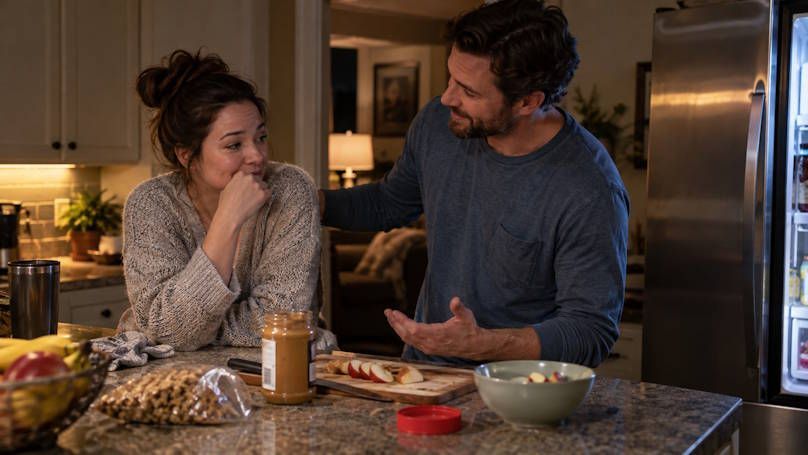
Example: The TV Snack
You finish dinner at 6:30.
At 8:00, your show starts.
You sit down.
Within ten minutes you start thinking about chips.
You are not particularly hungry.
But chips and television have been paired for years.
A behavioral approach might focus on breaking that association.
During hypnosis, you could mentally rehearse:
Sitting in the chair.
Starting the show.
Noticing the thought about chips.
Recognizing:
That is the old routine.
Then choosing what you actually want to do.
The important part is not whether you never eat chips again.
It is whether the decision becomes intentional.
Example: “I Deserve Something After Today”
You have had a brutal day.
Difficult client.
Traffic.
Family responsibilities.
Problems at work.
You finally sit down at 9:00 p.m.
Then comes the thought:
I deserve something.
There is nothing inherently wrong with enjoying food.
The issue arises when food becomes the automatic answer to every stressful day.
A more useful question is:
What am I actually asking for?
Comfort?
Relief?
Pleasure?
A transition?
Time alone?
Rest?
Once you understand the reward, you have more choices about how to create it.
Example: Boredom Eating
You are watching television, but you are not especially interested in what you are watching.
You scroll.
You walk into the kitchen.
Open the refrigerator.
Close it.
Open the pantry.
Nothing sounds particularly exciting.
Then you eat anyway.
That may be less about hunger than stimulation.
The brain is looking for something interesting.
Recognizing that pattern matters because the alternative response may have nothing to do with food.
What If I Crave Only Certain Foods at Night?
Specific cravings are common.
Someone may say:
I never crave chicken and vegetables at 10:30 p.m. I want cookies.
Or chips.
Chocolate.
Ice cream.
Bread.
Cereal.
Those preferences do not automatically prove an “addiction.”
Cravings can be influenced by many factors, including:
- taste,
- reward,
- restriction,
- routine,
- stress,
- availability,
- fatigue,
- and learned associations.
If you have spent weeks telling yourself:
I am never allowed to eat that food,
the food can also become psychologically more important.
So the objective should not automatically be greater restriction.
It should be understanding the pattern.
Does Eating Late at Night Automatically Cause Weight Gain?
The relationship between meal timing, metabolism and body weight is more complicated than a simple rule such as:
Never eat after 8 p.m.
Researchers are actively studying how eating timing interacts with circadian rhythms, sleep and metabolism. Reviews suggest that later eating patterns may be associated with metabolic and weight-related differences, but findings are not uniform and timing is only one part of a much larger picture that includes overall intake, sleep, activity and individual health factors.
That means this article is not recommending an arbitrary food curfew.
The focus is on repetitive, unwanted snacking that feels disconnected from physical hunger or personal goals.
Is Late-Night Snacking the Same as Night Eating Syndrome?
No.
This distinction is important.
Night Eating Syndrome, or NES, is a recognized feeding or eating disorder.
It is not simply:
I ate popcorn after dinner.
Clinical descriptions of NES involve patterns such as substantial evening food intake and/or repeated nighttime awakenings associated with eating, along with additional diagnostic considerations and distress or impairment.
If you suspect you may have Night Eating Syndrome, another eating disorder or episodes involving significant loss of control around food, seek appropriate professional evaluation rather than trying to treat the situation as a simple habit.
What About Eating While Partially Asleep?
That is also different.
Some people experience sleep-related eating behavior in which they may eat during partial arousal from sleep and have limited awareness or memory of the event.
That is not the same as consciously sitting on the couch at 10:00 p.m. and deciding to snack.
Unusual nighttime eating, especially when accompanied by confusion, injuries, dangerous food preparation or poor memory of the event, deserves medical or sleep-specialist evaluation.
Why Shame Usually Makes the Pattern Harder to Change
A common cycle looks like this:
You snack at night.
Then tell yourself:
I have no discipline.
The next morning you decide:
Today I will barely eat anything.
You restrict.
By evening you are hungry, tired and frustrated.
Then the eating happens again.
And afterward:
See? I knew I had no willpower.
That cycle can become incredibly discouraging.
Shame provides very little useful information.
Curiosity provides much more.
Instead of:
What is wrong with me?
ask:
What keeps happening here?
That question can reveal something you can actually change.
What Else Can Help With Late-Night Snacking?
Hypnosis is only one possible tool.
What makes sense depends on what is driving the behavior.
- If the main issue is true hunger, adequate daytime nutrition may matter most.
- If the main issue is stress, better stress regulation may matter.
- If the main issue is a powerful environmental cue, changing the routine or environment may help.
- If the behavior involves significant emotional distress, loss of control or eating-disorder symptoms, licensed professional care may be more appropriate.
Hypnosis may fit best when the problem involves learned cues, automatic routines, cravings or emotionally reinforced behaviors.
Late-Night Snacking Support Options
| Support Option | What It May Address | Important Boundary |
|---|---|---|
| Adequate daytime nutrition | Evening hunger related to under-eating or restrictive dieting | Nutrition needs are individual; a registered dietitian can help when intake is complicated. |
| Environment and routine changes | Visible food cues and repeated TV/kitchen habits | Helpful for habits but not a substitute for clinical care when eating is distressing or disordered. |
| Stress-management support | Eating used for comfort after difficult days | Persistent anxiety, depression, or trauma may need licensed mental-health care. |
| Behavioral hypnosis | Learned cues, automatic routines, cravings, and emotional associations | Supportive behavior-change tool; not a guaranteed weight-loss treatment. |
| Medical or eating-disorder evaluation | Night Eating Syndrome, sleep-related eating, medication effects, diabetes, or other medical concerns | Important when symptoms are persistent, unusual, medically concerning, or involve loss of control. |
Can Hypnosis Help If Diets Have Failed Before?
Possibly, depending on why previous attempts failed.
If every diet was defeated by the same evening routine, understanding that routine may reveal something the diet never addressed.
Maybe the plan told you what to eat.
But not what to do when you felt stressed at 9:30.
Maybe it gave you calories.
But not a strategy for boredom.
Maybe it gave you meal plans.
But ignored the fact that food had become your reward after difficult days.
That is one reason a behavior-focused approach can be useful.
Oklahoma City Elite Hypnosis works with several habit-based and emotionally reinforced concerns, which you can review through the broader Oklahoma City Elite Hypnosis service options if late-night snacking overlaps with stress, confidence, smoking, sleep or another behavior you want to change.
What Happens During a Remote Hypnosis Session?
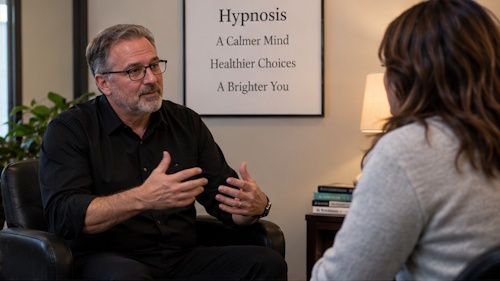
Oklahoma City Elite Hypnosis provides private remote video sessions for adults in Oklahoma City and surrounding Oklahoma communities.
The conversation comes first.
For late-night snacking, useful questions may include:
- What time does the eating usually start?
- What foods do you normally reach for?
- Are you physically hungry?
- What happened right before the urge?
- Are you watching television?
- Are you stressed?
- Are you bored?
- Does the behavior happen every night?
- Are you restricting food earlier in the day?
- Does the eating feel controlled or uncontrolled?
- What does the snack seem to provide emotionally?
Those answers help identify the real pattern.
If hypnosis appears appropriate, the session can then focus on rehearsing different responses to the cues that normally trigger eating.
Why Remote Sessions Can Be Convenient in Oklahoma City
Because the practice is 100% remote, adults in Oklahoma City, Edmond, Moore, Norman, Yukon, Mustang, Bethany, Nichols Hills, Midwest City and surrounding Oklahoma communities can participate from a private location without adding another drive across the metro.
For busy adults, that can make scheduling easier.
Remote convenience should not be confused with a claim that online hypnosis is automatically better than every in-person option. It is simply a practical format that many clients prefer.
What Would Realistic Progress Look Like?
Not:
I will never want a snack again.
That is neither necessary nor realistic.
Progress might look like:
- You notice the urge before you stand up.
- You can tell the difference between hunger and habit more often.
- You can watch television without automatically eating.
- You choose a snack deliberately when you genuinely want one.
- A stressful day does not automatically end with food.
- You can experience a craving without immediately responding.
- You stop treating one imperfect evening as a reason to give up.
Those are meaningful behavioral changes.

Frequently Asked Questions About Late-Night Snacking and Hypnosis
Can hypnosis stop late-night snacking?
Hypnosis may help some adults change learned triggers, cravings and automatic routines associated with nighttime eating. It should not be presented as a guaranteed way to eliminate all evening eating.
Why am I hungry every night after dinner?
There are many possibilities. You may not have eaten enough during the day, your dinner may not be satisfying enough for your needs, or the urge may be connected to habit, stress or another cue.
Why do I only want junk food at night?
Highly preferred foods may be connected to reward, restriction, routine, stress or learned associations. A specific craving does not by itself establish an addiction.
Is eating after 8 p.m. bad?
There is no universal rule that everyone must stop eating at a particular clock time. Your overall eating pattern, individual health needs, sleep, activity, quantity and reasons for eating matter.
Can hypnosis help emotional eating?
Hypnosis may be used as a supportive behavioral tool for emotional triggers and automatic responses. Significant emotional eating or eating-disorder symptoms may also require licensed mental-health or nutrition care.
Is late-night snacking the same as Night Eating Syndrome?
No. Night Eating Syndrome is a recognized feeding or eating disorder with specific clinical features. Ordinary evening snacking should not be self-diagnosed as NES.
Should I avoid eating if I am genuinely hungry at night?
This article is not advising people to ignore physical hunger. If you regularly experience strong nighttime hunger, look at your overall eating pattern and consider appropriate nutrition or medical guidance when needed.
What if I wake up during the night and eat?
Repeated nighttime awakenings with eating can be different from ordinary late-night snacking and may deserve clinical evaluation, particularly if the behavior is frequent, distressing or occurs with limited awareness.
Can I use hypnosis while working with a dietitian or therapist?
Potentially. Hypnosis can be used as complementary behavior-change support. It should not replace medical, nutrition, eating-disorder or mental-health treatment when those services are appropriate.
The Goal Is Not Perfect Eating—It Is More Choice
Late-night snacking can feel frustrating because it often happens after you have spent the entire day making good intentions.
But repeated nighttime eating is not proof that you are lazy or incapable of change.
There is usually a pattern.
Something triggers the urge.
The behavior provides something.
The brain learns the routine.
And the routine becomes easier to repeat.
Understanding that sequence gives you a place to intervene.
For some people, the answer may involve eating more adequately earlier in the day.
For others, it may mean changing the environment.
Managing stress differently.
Creating a new evening routine.
Or working with a habit that has become automatic.
Hypnosis may provide one useful tool for that behavioral work when it fits the person and the problem.
Ready to Talk Privately?
If you are an adult in Oklahoma City or a surrounding Oklahoma community and late-night snacking repeatedly feels automatic, frustrating or disconnected from physical hunger, Oklahoma City Elite Hypnosis offers private remote hypnosis sessions.
The first step is understanding why the pattern is happening.
If hypnosis appears appropriate, the work can focus on the triggers, routines and responses you actually want to change.
Call Oklahoma City Elite Hypnosis at 580-408-2258 or
use the website contact form to request a private conversation.