Oklahoma City Elite Hypnosis Blog
Agency Contact Form
Can Hypnosis Help You Stop Vaping in Oklahoma City?

If you have tried to stop vaping but keep finding yourself reaching for the device during stress, driving, work breaks, boredom or other familiar moments, you may be wondering whether hypnosis can help. The most useful answer is not that hypnosis somehow makes nicotine dependence disappear. It does not.
Hypnosis may, however, help some adults work on the behavioral patterns and learned triggers surrounding vaping. Those patterns can become so familiar that reaching for a vape starts happening almost automatically.
For someone in Oklahoma City who genuinely wants to stop vaping, hypnosis may therefore be one part of a broader quit plan that also considers nicotine withdrawal, healthcare guidance, trigger management and established cessation support.
| Topic | Details |
|---|---|
| Hypnosis goal | Behavioral support for adults trying to stop vaping |
| Provider | Oklahoma City Elite Hypnosis |
| Primary service area | Oklahoma City and surrounding Oklahoma communities |
| Session format | Private remote video hypnosis |
| Behavioral patterns that may be addressed | Automatic vaping routines, stress vaping, boredom vaping, driving cues, social triggers and learned associations |
| Nicotine dependence | Hypnosis does not directly treat or eliminate nicotine withdrawal |
| Established quit support | Quit planning, healthcare guidance, trigger management and evidence-based cessation support where appropriate |
| Best fit | Adults who recognize repeated behavioral triggers and want additional support practicing different responses |
| Not a promise of | Guaranteed quitting, elimination of withdrawal, medical treatment or permanent removal of cravings |
| Contact | 580-408-2258 |
| Website | Oklahoma City Elite Hypnosis |
Why Can Vaping Become So Automatic?
Vaping is not always a single, deliberate decision repeated several times per day.
For some people, it becomes woven into dozens of ordinary activities.
You might vape:
- While driving
- With your morning coffee
- While scrolling on your phone
- During work breaks
- After eating
- When you feel stressed
- When you are bored
- While drinking alcohol
- While talking with friends who vape
- When you need something to do with your hands
- When you are trying to focus
- At the end of a difficult day
Over time, these situations can become cues.
The person may eventually notice that getting into the car creates an urge to vape, coffee seems incomplete without it, or stress causes their hand to reach for the device almost before they have consciously decided to use it.
That automatic quality is one reason quitting can feel more complicated than simply deciding, “I am not going to vape anymore.”

Is Quitting Vaping the Same as Quitting Cigarettes?
There are similarities because both behaviors may involve nicotine dependence, cravings, withdrawal and learned routines.
The behavioral pattern, however, can look different.
A cigarette usually has a more obvious beginning and end. Vaping can sometimes occur in much shorter bursts throughout the day.
Someone may take a few puffs while working, another few while driving, another while looking at their phone and several more during a stressful conversation.
That can create a large number of small behavioral associations.
| Smoking | Vaping |
|---|---|
| Often involves finishing one cigarette | Vaping may involve repeated shorter use |
| Frequently occurs during specific breaks or locations | Some people vape across many different activities |
| Lighting a cigarette creates a clear behavioral step | A vape may be immediately available |
| Smoke and odor can make the behavior more noticeable | Vaping may be easier to conceal |
| Smoking is often restricted to certain locations | Vaping may become linked with cars, home offices or other private settings |
| A cigarette has a clearer beginning and end | Some people take repeated puffs throughout the day |
These differences do not mean vaping is automatically harder to quit than smoking.
They simply mean that someone trying to stop vaping may need to identify many small situations in which the behavior has become familiar.
What Are Common Triggers for Vaping?
A trigger is something associated with the urge to vape.
Triggers differ from person to person.
For one Oklahoma City client, driving may be the biggest trigger. For another, it may be stress after work. Someone else may notice the urge whenever they drink coffee, scroll through social media or spend time around other people who vape.
Identifying those patterns matters because a quit plan becomes much more useful when you know what situations you are actually preparing for.
| Trigger | What You Might Notice | Learned Association |
|---|---|---|
| Stress | I need something right now. | Vaping becomes associated with relief or a brief pause |
| Boredom | I need something to do. | The device becomes stimulation during empty moments |
| Driving | I always vape in the car. | Getting into the vehicle predicts vaping |
| Coffee | Coffee makes me want my vape. | Two repeated behaviors become paired |
| Work breaks | This is how I take a break. | Vaping becomes part of stepping away from work pressure |
| Phone scrolling | I do it without thinking. | Screen time repeatedly occurs alongside vaping |
| After meals | I want it as soon as I finish. | The end of eating becomes a cue |
| Alcohol | I vape much more when I drink. | Drinking environments and lowered inhibition can increase risk |
| Stress or anxiety | Vaping helps me calm down. | Emotional discomfort begins predicting the behavior |
| Social situations | Everyone else is vaping. | Other users and social settings trigger expectation |
| Seeing a vape | I suddenly want mine. | Visual reminders activate the learned association |
Federal quit-vaping resources also encourage people to identify their personal triggers and plan different responses to them. That is important because trying to avoid every trigger forever is usually unrealistic. The more practical goal is to recognize what tends to happen and decide ahead of time what you want to do differently.
What Does a Vaping Habit Loop Look Like?
One way to understand repeated vaping is as a behavioral loop.
Something happens first.
Maybe you get into the car.
Maybe work becomes stressful.
Maybe you finish dinner.
Maybe you pick up your phone.
That cue is followed by an expectation or urge. The person then vapes, experiences nicotine delivery, distraction, stimulation or temporary relief, and the association between the situation and vaping becomes familiar again.
If you are also looking for broader help with cigarettes, vaping, dipping, or other tobacco routines, learn more about
quit smoking hypnosis in Oklahoma City.
| Stage | What Happens |
|---|---|
| Cue | Driving, coffee, stress, boredom, phone use, alcohol, another person vaping or another learned trigger |
| Expectation / Urge | The person anticipates nicotine, relief, stimulation or the familiar action |
| Response | The device is picked up and vaping occurs |
| Immediate Effect | Nicotine delivery, sensory stimulation, distraction or temporary relief occurs |
| Reinforcement | The cue and vaping become associated again |
| Next Opportunity | The same cue appears later and the learned response becomes easier to repeat |
The important point is that this does not have to be interpreted as a character flaw or lack of motivation.
Repeated behaviors become easier to repeat when the same cues and responses occur together again and again.
Breaking the pattern means creating opportunities for a different response.
Where Might Hypnosis Fit Into Quitting Vaping?
Hypnosis is generally used here as behavioral support, not as a treatment for nicotine withdrawal.
During hypnosis, a person typically enters a focused and relaxed state in which attention can be directed toward specific goals, imagery and mental rehearsal.
For a vaping habit, that work might focus on things such as:
- Recognizing a trigger earlier
- Mentally rehearsing being in the car without vaping
- Separating coffee from automatically reaching for the device
- Responding differently during stress
- Becoming more aware of automatic hand-to-mouth routines
- Strengthening the person's reasons for quitting
- Rehearsing how they want to respond around other people who vape
- Imagining themselves moving through an ordinary day without relying on the device
The goal is not to convince someone that cravings or nicotine withdrawal do not exist.
The goal is to work on the behavioral side of the pattern.
What Hypnosis Does Not Do
It is equally important to be clear about what hypnosis should not be expected to do.
Hypnosis does not directly remove nicotine from the body.
It does not guarantee that someone will never experience another craving.
It should not replace healthcare advice when someone has questions about nicotine dependence, withdrawal symptoms, medications or other health concerns.
And no ethical hypnosis provider should promise that every person will quit permanently after a particular number of sessions.
Quitting experiences vary.
For that reason, behavioral hypnosis makes more sense when it is viewed as one possible part of a larger quit strategy rather than a magical substitute for everything else.

What About Nicotine Withdrawal?
Most vaping products contain nicotine, and stopping nicotine can produce withdrawal symptoms.
Those symptoms can include irritability, restlessness, difficulty concentrating, sleep changes, increased appetite and strong cravings.
Some people experience relatively manageable symptoms. Others find withdrawal much more disruptive.
That is why the distinction between nicotine withdrawal and behavioral triggers matters.
A behavioral trigger might be:
“I always vape when I drive.”
Withdrawal might feel more like:
“I have not used nicotine and now I feel intensely restless and irritable.”
Those can overlap, but they are not exactly the same problem.
Someone concerned about nicotine withdrawal should consider discussing quitting with a physician or other qualified healthcare professional. Free quit-support resources are also available through national smoking and tobacco cessation programs.
Should Hypnosis Replace Other Quit-Vaping Support?
No.
There is no reason these approaches need to compete.
Someone might use several forms of support at the same time.
| Quit Component | What It Addresses |
|---|---|
| Quit planning | Defines the quit date, reasons for stopping, trigger plan and support strategy |
| Trigger management | Identifies people, places, emotions and routines that prompt vaping |
| Healthcare support | Addresses medical questions, nicotine dependence and individual health considerations |
| Withdrawal management | Helps the person prepare for or manage nicotine-withdrawal symptoms using appropriate evidence-based guidance |
| Social support | Provides accountability, encouragement and help during difficult moments |
| Behavioral hypnosis | May help rehearse different responses to established cues, routines and automatic vaping patterns |
For some adults, the strongest approach may involve several of these pieces working together.
The medical side of quitting can address nicotine-related questions.
Quit-planning resources can help prepare for difficult situations.
Friends, family members or quit coaches can provide encouragement.
Hypnosis can focus specifically on rehearsing different responses to familiar cues and routines.
What Happens During Remote Hypnosis for Vaping?
Oklahoma City Elite Hypnosis currently provides private hypnosis sessions remotely by secure video. That means Oklahoma City-area clients can participate from their own space rather than traveling to an office.
A vaping-focused session would generally begin by identifying the person's actual pattern.
Useful questions may include:
- When do you vape most often?
- What situations trigger you?
- When have previous quit attempts become difficult?
- Is stress a major trigger?
- Do you vape while driving?
- Is vaping connected with coffee, alcohol or meals?
- Do you automatically reach for the device while using your phone?
- Are other people around you frequently vaping?
- What do you want to do instead when those situations occur?
- Why is quitting important to you now?
Those details give the hypnosis session something concrete to work with.
“Stop vaping” is a broad goal. “I want to drive home from work without automatically reaching for my vape when traffic becomes stressful” is a much more specific behavioral target.
Can Remote Hypnosis Work for Behavioral Habits?
Remote hypnosis does not require the hypnotist to physically touch the client.
The session depends on communication, focused attention and the client's ability to hear and follow the process.
For many clients, participating from home also removes travel time and allows them to work from a private, familiar environment.
As with any hypnosis session, participation matters.
A person cannot be forced into hypnosis against their will, and hypnosis does not remove personal control.
The client remains an active participant in the process.
If you want a step-by-step explanation of what an appointment looks like, see
what happens during quit smoking hypnosis.

Who May Be a Good Fit for Quit-Vaping Hypnosis?
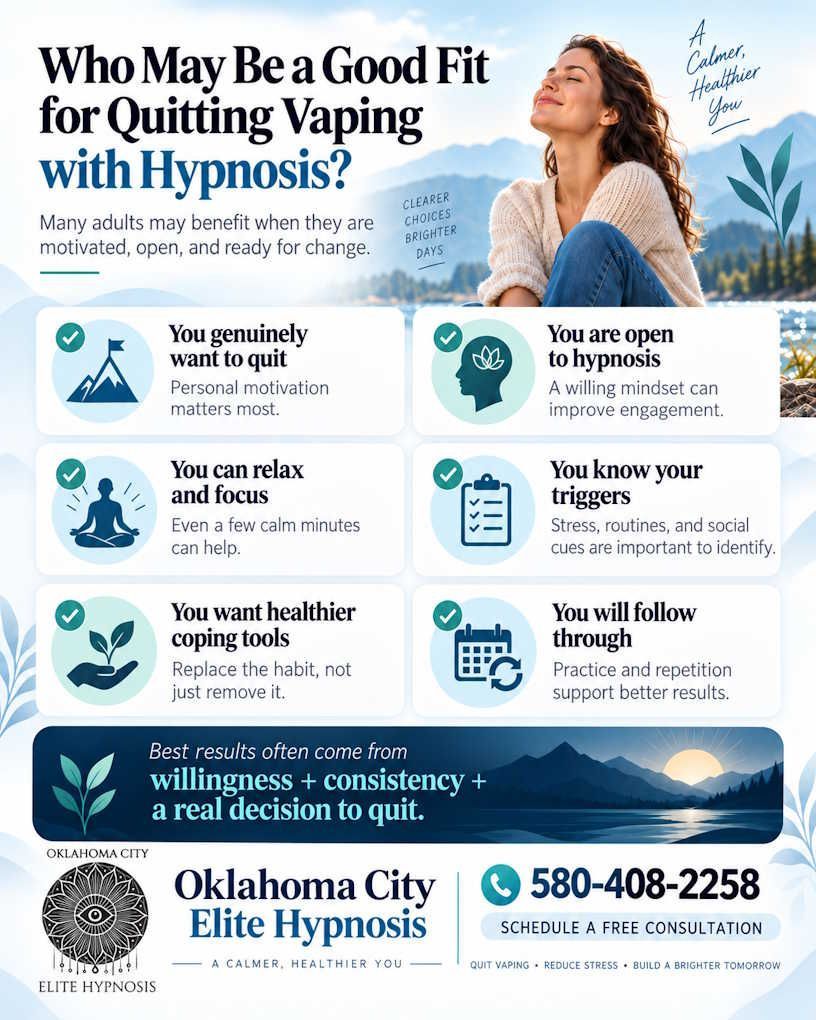
Someone may be worth considering for behavioral hypnosis support if they:
- Actually want to stop vaping
- Recognize clear triggers or automatic routines
- Have repeatedly returned to vaping during particular situations
- Want additional help changing the behavioral side of the habit
- Understand that hypnosis is not a guaranteed cure
- Are willing to prepare for nicotine withdrawal separately when needed
- Are open to practicing different responses outside the hypnosis session
Hypnosis is not about convincing someone to quit when they have no real interest in quitting. Motivation and participation still matter. You can also explore the broader Oklahoma City Elite Hypnosis services if vaping is only one part of what you want help changing.
What Should You Do Before Trying to Quit?
Before your quit attempt, spend a little time identifying what vaping currently does for you. Not what you wish it did.
What it actually does in your daily routine.
Ask yourself:
- When do I reach for it automatically?
- Which situations make the urge strongest?
- What am I expecting to feel after I vape?
- Which people or places are connected with it?
- What happened during previous attempts to stop?
- Which part worries me most: withdrawal, cravings, stress, boredom, routines or social situations?
Those answers can make both quit planning and hypnosis more focused.
It may also help to choose a quit date, remove vaping supplies, identify people who can support you and plan ahead for situations in which you normally vape.
What If You Slip and Vape Again?
One lapse does not have to become a complete return to the old routine.
Instead of treating it as proof that quitting failed, look at what happened immediately beforehand.
- Where were you?
- What were you feeling?
- Who were you with?
- What were you doing?
- What thought went through your mind?
That information helps identify a trigger that may need a better plan next time.
Behavior change is often easier when setbacks are treated as information rather than as an excuse to abandon the entire goal.
If you are new to hypnosis and want answers about awareness, control, safety, remote sessions, and what hypnosis feels like, visit our frequently asked questions about hypnosis.
Is Hypnosis Enough by Itself to Stop Vaping?
There is not a responsible one-size-fits-all answer.
Some people primarily struggle with strong behavioral routines. Others experience significant nicotine dependence and withdrawal. Many deal with both.
That is why Oklahoma City Elite Hypnosis does not need to position hypnosis as being in competition with medical support, quit coaching or established cessation resources.
The more useful question is: Would additional behavioral support help you respond differently to the situations that repeatedly lead you back to vaping? If the answer may be yes, hypnosis is one option worth discussing.
Ready to Talk About Your Vaping Patterns?
If you are in Oklahoma City or a surrounding Oklahoma community and want to explore whether remote hypnosis could support the behavioral side of your quit-vaping plan, Oklahoma City Elite Hypnosis offers private remote sessions.
Call 580-408-2258 or send a brief message through the website to request a callback.
The first conversation is an opportunity to discuss your vaping triggers, previous attempts to quit and what type of support may make sense for your situation.
Hypnosis is not a guaranteed cure for nicotine dependence and does not replace appropriate medical care.
It can, however, be one tool for adults who want focused help changing the routines, cues and automatic responses that have become connected with vaping.
Frequently Asked Questions
Can hypnosis make me stop vaping instantly?
Hypnosis should not be presented as a guaranteed instant cure. Some people use hypnosis as behavioral support while working on the triggers and routines associated with vaping.
Does hypnosis eliminate nicotine withdrawal?
No. Hypnosis does not directly eliminate nicotine withdrawal. If withdrawal is a concern, consider speaking with a qualified healthcare professional about appropriate support.
Can hypnosis help with stress vaping?
It may help some people work on the behavioral association between stress and automatically reaching for a vape. The goal is to practice and reinforce different responses to that trigger.
What if I vape while driving?
Driving is a common type of routine trigger. A hypnosis session may focus on mentally rehearsing driving situations without automatically reaching for the device and developing alternative responses.
Do I need to live inside Oklahoma City?
Oklahoma City Elite Hypnosis provides remote video sessions, so clients can participate from their own location wherever they feel most comfortable.
Can I use hypnosis along with other quit-vaping support?
Yes. Hypnosis does not need to replace quit planning, healthcare guidance, social support or established cessation resources. Different forms of support may address different parts of the quitting process.